
China is the undisputed global leader in stainless steel jewelry manufacturing, holding 52.3% of the world’s production capacity (≈186,000 tons annually) and dominating both domestic and export markets. Its factories benefit from mature industrial clusters, advanced automation, competitive costs, and strong design agility, while facing challenges like rising competition, stricter environmental rules, and shifting consumer demands. Below is a detailed breakdown.
You will Learn in this Post
1. Industrial Scale & Market Position
- Market Size: The 2025 Chinese stainless steel jewelry market reached CNY 142.8 billion (USD 19.8 billion), with a 12.4% year-on-year growth; 2026 is projected at CNY 169.5 billion (+13.0%).
- Factory Count: ~1,247 dedicated stainless steel jewelry factories nationwide (2025), 68.3% with ISO 9001 certification, 33.0% with in-house electroplating lines (including cyanide-free processes), and 289 with fully automated stamping lines (≥500,000 pieces/month).
- Global Export Leadership: 2025 exports hit CNY 28.6 billion (+11.7%), with a trade surplus of CNY 25.5 billion. Key destinations: Southeast Asia (34.2%), EU (27.5%), North America (19.8%), and Africa (fast-growing, especially religious styles).
- Product Mix: Rings (30.1%, CNY 45.2B), necklaces/pendants (25.8%, CNY 38.7B), bracelets (28.4%, CNY 42.6B), earrings (16.0%, CNY 24.0B).
2. Core Industrial Clusters & Regional Strengths
China’s production is highly concentrated in four major hubs, each with distinct specialization and supply chain advantages:
(1) Dongguan (Guangdong) – Precision & High-Volume OEM
- Location: Chang’an Town (2,500+ factories, “Stainless Steel Jewelry Capital”).
- Strengths: 316L surgical-grade steel expertise, CNC machining, laser engraving, PVD coating (18K gold, rose gold, black). Monthly capacity per factory: 100,000+ pieces; total annual output: 30 billion pieces.
- Focus: Custom rings, engraved bracelets, tech-integrated jewelry (e.g., watch straps).
(2) Shenzhen & Guangzhou (Guangdong) – Mid-to-High-End & Design-Driven
-
Shenzhen: Premium electroplating (IP, PVD), hypoallergenic nickel-free lines, RoHS/REACH compliance. Home to BSCI-certified factories serving luxury brands.
-
Guangzhou (Panyu/Baiyun): “China’s Jewelry Capital” with strong ODM design capabilities (300–500 new styles monthly). Specializes in waterproof, fade-resistant PVD-plated pieces for global fashion brands.
(3) Yiwu (Zhejiang) – Low-Cost, Fast-Turnaround & Small MOQ
- Position: World’s largest small-commodity hub, 38% of China’s stainless steel jewelry component manufacturers.
- Strengths: Ultra-low MOQs (3–50 pieces/design), rapid sampling (3–7 days), mass production of minimalist/trendy styles. Ideal for Amazon/Etsy sellers and startups.
(4) Emerging Hubs
- Eastern China: Wenzhou (vintage chains), Qingdao (Korean-style cubic zirconia jewelry).
- Central China: Henan, Hubei (20.3% of national output in 2025, up from 7.2% in 2020) –Taking on the industrial transfer from the east means lower costs.
- Fujian: Putian/Quanzhou – strong in precision casting and religious jewelry (crosses, Muslim symbols).
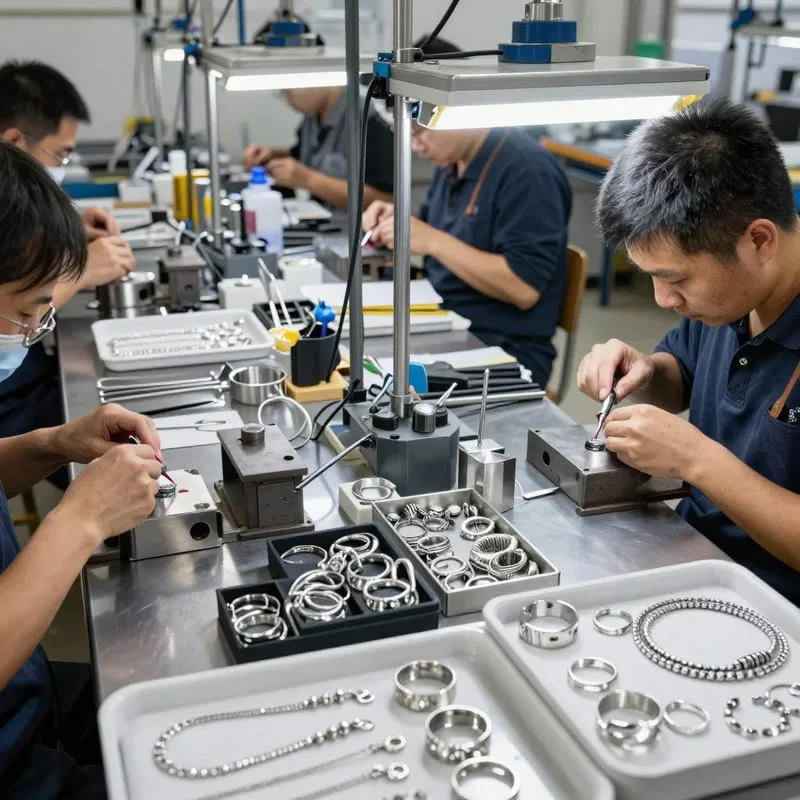
3. Production Technology & Manufacturing Capabilities
(1) Materials Expertise
- Primary material: 316L surgical stainless steel (hypoallergenic, corrosion-resistant, nickel-free options for sensitive skin).
- Secondary: 304 steel (cost-effective), titanium-steel composites (lightweight, high strength).
(2) Advanced Processes
- Automation: 60–80% of production uses CNC stamping, laser cutting, robotic polishing – reduces labor costs, improves consistency, and shortens lead times (average 15.2 days in 2025, down from 18.5 days in 2024).
- Surface Finishing:
- PVD Vacuum Plating: 5–10 year fade resistance (gold, rose gold, black, gunmetal) – standard for mid-to-high-end brands.
- IP Plating: High-shine, scratch-resistant – used for luxury OEM orders.
- Cyanide-Free Electroplating: Eco-friendly, compliant with EU REACH and US CA65 regulations.
- Quality Control: 6-stage polishing + 6-stage inspection (Zhefan Jewelry example) – defect rates <1% for export orders.
(3) OEM/ODM Dominance
- OEM: Mass production for international brands (e.g., Zara, Pandora, local Amazon sellers) – low MOQs (500–1,000 pieces), competitive pricing ($2–$15/piece).
- ODM: In-house design teams (5–20 designers per factory) – 300–500 new styles monthly, trend forecasting aligned with global fashion weeks.
- Private Label: Full-service support (logo engraving, custom packaging, dropshipping) – ideal for small-to-mid brands.
4. Key Advantages of Chinese Factories
- Unmatched Cost Efficiency: 30–50% lower than European/US manufacturers, 10–20% lower than Southeast Asian rivals (Vietnam, Thailand) – driven by economies of scale, automated production, and integrated supply chains (raw materials, components, plating, packaging all within 50km in clusters).
- Design Agility & Speed: Fast response to global trends (TikTok/Instagram viral styles sampled in 3–5 days); large design teams ensure constant newness for retailers.
- Regulatory Compliance: Deep expertise in RoHS, REACH, CA65, BSCI, and nickel-free standards – critical for EU/US market access.
- Flexible MOQs: From 3 pieces (Yiwu) to 100,000 pieces (Dongguan) – caters to startups, mid-sized brands, and multinational corporations alike.
5. Major Challenges & Risks
(1) Intensifying Global Competition
- Southeast Asia: Vietnam, Thailand, and Indonesia (backed by nickel reserves) are scaling up, offering 10–15% lower labor costs – targeting low-to-mid-end mass market.
- Domestic Overcapacity: 1,200+ factories competing for orders – price wars eroding profit margins (average net margin: 5–8% in 2025).
(2) Stricter Environmental & Labor Regulations
- Cyanide-Free Plating Mandates: All factories must switch to eco-friendly processes by 2027 – 33% already compliant, others face high upgrade costs (CNY 500,000–2 million per line).
- Rising Labor Costs: 8–10% annual wage hikes in Guangdong/Zhejiang – pushing low-end production to central China or Southeast Asia.
(3) Supply Chain & Raw Material Volatility
- Stainless Steel Price Fluctuations: Nickel (key alloy) prices rose 25% in 2025 – squeezing margins for factories without long-term supply contracts.
- Logistics Costs: 15–20% increase in sea freight post-pandemic – impacting export profitability.
(4) Evolving Consumer Demands
- Sustainability: Buyers demand recycled steel, zero-waste production, and ethical labor – requiring factories to adopt ESG practices.
- Personalization: Growth in custom engraving, birthstone jewelry, and minimalist designs – factories must invest in flexible production lines.
6. Future Trends (2026–2028)
- Automation 2.0: 90% of factories to adopt AI-driven quality control and smart production lines – further reducing labor reliance and improving efficiency.
- High-End Upgrade: Shift from low-cost OEM to ODM/private label – focusing on premium PVD finishes, hypoallergenic designs, and sustainable materials to compete with Italian luxury brands.
- Cross-Border E-Commerce Boom: 40% of sales via Amazon, Etsy, TikTok Shop, and AliExpress – factories building dropshipping capabilities and small-batch quick-response systems.
- Regional Diversification: More factories moving to central China (Henan, Hubei) or Southeast Asia to cut costs, while keeping design/headquarters in Guangdong/Zhejiang.
Conclusion
Chinese stainless steel jewelry factories are the backbone of the global industry, combining scale, speed, technology, and cost efficiency that no other region can match. While facing challenges from competition, regulation, and shifting demands, their agility and manufacturing prowess position them to maintain leadership through upgrading to high-end ODM, embracing sustainability, and leveraging cross-border e-commerce. For global buyers, China remains the most reliable, flexible, and cost-effective sourcing destination for stainless steel jewelry in 2026 and beyond.
